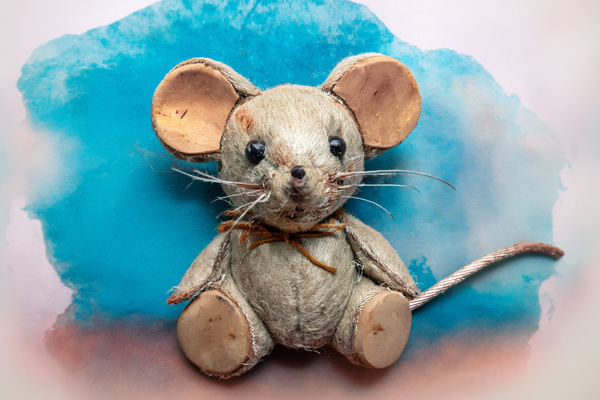
The little gray mouse was tattered nearly beyond recognition. If you hadn’t seen its original form, you might have thought it was a blob of fuzz or a wadded piece of drier lint. One ear and an eye were the most distinguishable remnants. A stubby piece of cloth was all that remained of its tail. Only the tiny red nose was still intact. Somewhat. Certainly, the former cat toy had seen better days.
Despite its decrepit appearance, the mouse was a big deal for our cat Maddie’s well-being after our move. The three-year-old gray striped tabby could have picked any plaything from her toy box. No. She only had eyes for the mouse.
What made Maddie’s choice unusual was that she had not played with the mouse for more than a year. That was when my wife and I found her at a shelter in Panora, Iowa. Her foster mother told us the cat was inseparable from the mouse that rattled when shaken. Maddie’s routine didn’t stop when we brought her to our home. Just like an expert retriever, she returned the mouse to me every time I lobbed it across the living room. She seemed proud to snatch the toy in her mouth, trot to where I sat, and drop the mouse at my feet.
When we moved in April 2024, Maddie resumed playing with and fetching the mouse. Then it struck us. Maddie was using the mouse as a way to cope with the relocation in much the same way as she found the mouse a source of comfort when we first adopted her.
According to Very Well Mind, moving is one of the top three stressors in life for humans. Long-range relocations can be highly stressful, but even short-range moves can create anxiety. Packing, arranging for utility changes, meeting new neighbors, and communicating a new address to acquaintances require the same effort no matter the distance.
Humans have several ways to deal with those challenges, but what about their pets? Four-footed family members are also prone to displacement anxiety. An article on progressive.com’s website highlights the effects of removing them from familiar surroundings and routines. According to the Grady Veterinary Hospital in Cincinnati, paying extra attention to a pet before a move and ensuring they have their special toys after a move can help. For Maddie, it was her mouse.
Playing with her mouse was Maddie’s way to deal with the unknown and find comfort during a hectic situation. It was something familiar through which she could relive the days of being in a settled location. Although her home was now different, her mouse never changed.
Comfort is equally important to us humans. Take, for instance, comfort foods. They take us to memorable times in our lives, such as our childhood or Sunday dinners at grandma’s house. Some restaurants are known for comfort foods, like meatloaf and mashed potatoes.
You might also associate familiarity with a comforter. Typically placed as the top cover on a bed, a comforter’s role is to give warmth during cold winter months. However, the thick blanket is more than just a bed addition. It reminds us of the aunt who lovingly hand stitched the quilt many decades ago.
A person’s need for stress relief sometimes is found in a comfort animal. An American Kennel Club article indicated that, rather than service dogs that assist visually or hearing impaired individuals, comfort animals offer help with emotional needs and companionship.
We long for the familiar and the comfort of lasting friendships in a world of casual and fleeting acquaintances. We desire a life that gives respite from pressures of instant gratification and hurrying to keep up with society. Finding our own unique places of comfort can do that. The simple, reliable, and peaceful are waiting to bring us through our personal challenges and turmoil. Just like Maddie’s comfort mouse.